During this Webinar we talk about informal care, and the need help your client to see that they aren’t waiting until they have zero capacity for help to arrive. In order to get the client to plan more fully, we need to remove fear and stigma, and specifically address the belief that accepting help means being treated like a child and having all of your decisions made for you. In order to achieve this we will talk about informal help, or weekly paid help, or other forms of low friction support.
As a society we don’t discuss what it can look like for the person in need of care, when they have capacity, and their wishes and independence is being respected. As lawyers we see great examples of informal care, informal support, and people who have capacity but need help. They have capacity, but less than they had a decade ago, and they are being cared for in a way that maintains most of their independence. These stories tend to be kept secret, out of respect for the person in need of care, and so instead the public discussion is focused on the difficulties faced by informal carers, and situations where a person has no capacity and needs intervention from the Court or a Tribunal.
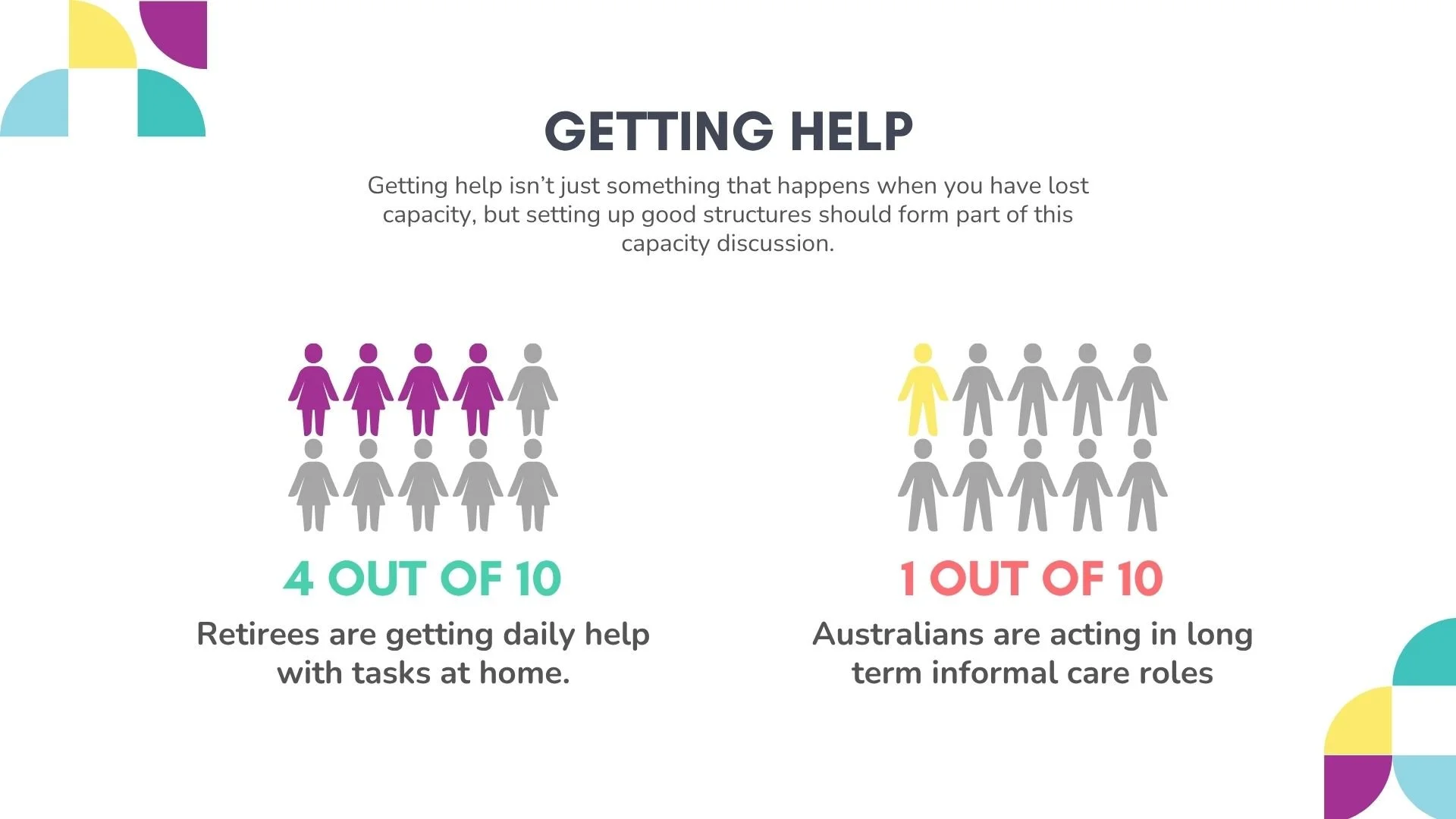
These situations need to be discussed, but are we talking to our clients about informal care done well? Are we talking to our clients about what they want their retirement to look like when they have mental capacity, but no longer have the energy to make the 70 decisions that we make a day? Have you told your clients that 40% of retirees are getting daily help with tasks at home, and this figure is referring to people who are at least partly receiving informal support. Have you told your clients that 11% of Australians are providing ongoing, long term informal care to a person, not a child, a person who for whatever reasons needs support. These are not people who have had decisions taken away from them, they are people receiving regular supports. Has your client considered this as part of their retirement, and what that might look like for them, and what they might need to do to facilitate this?
During this Webinar we will take a look at recent cases, what is trending as far as disputes about care and capacity are concerned, and then we will look at how to talk to our clients to get them to take this seriously, but also without scaring them away for three months. This Webinar will be run on Friday 12 June 2026 at 1pm AEST, it will cost $100 per person.
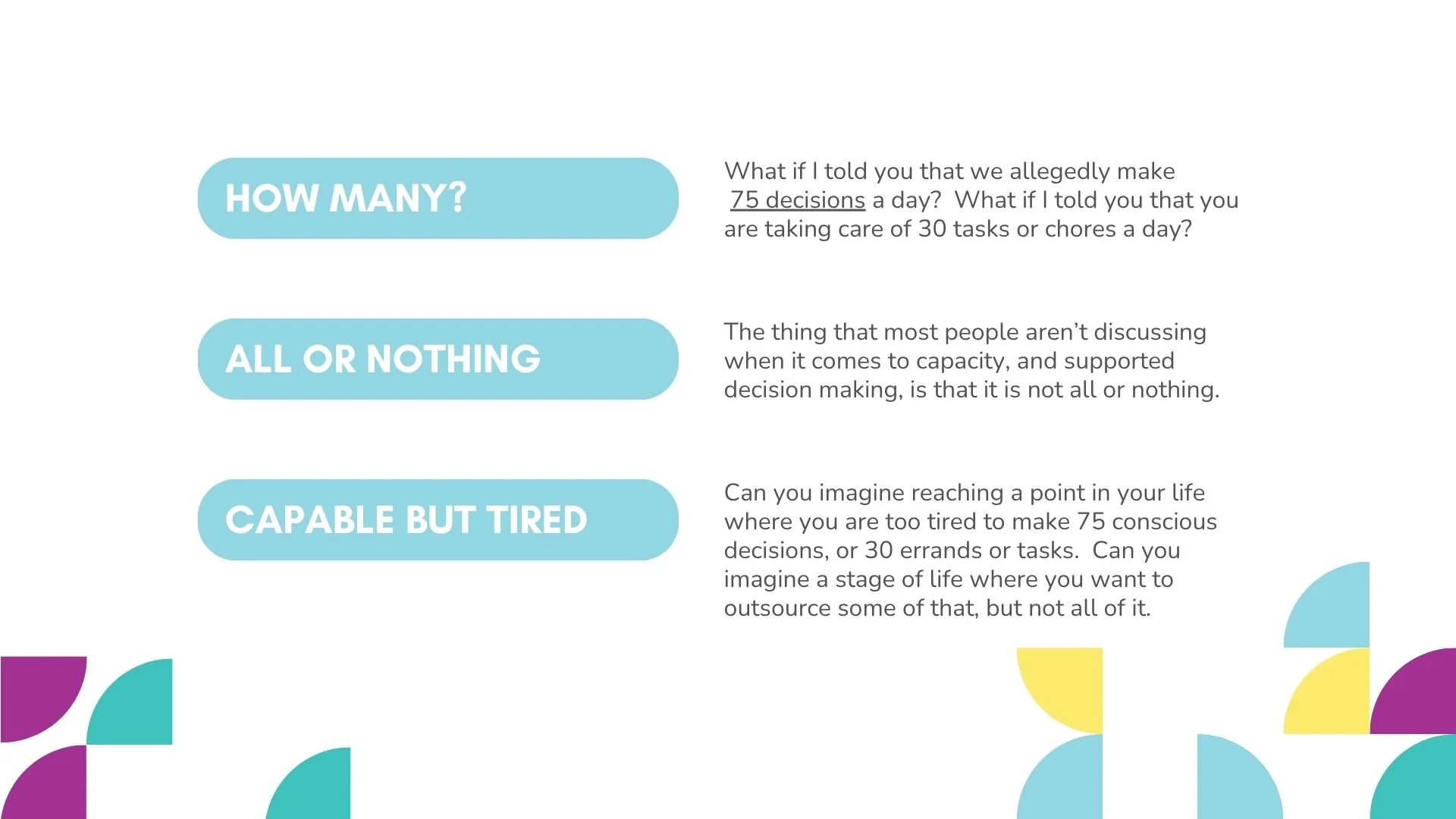
Discussing this stage of less capacity, but still having decision making capacity, it important firstly because it isn’t really happening in public discourse right now. We discuss elder abuse, and situations where capacity is lost, and they are important, but this middle ground is far more common. It should form part of the planning and considerations.
It also helps the client to take a more positive approach, how do you want this to look, what do you think daily help would look like in the home? What are some things that you would be happy to accept help with, and what are some things that you want to retain?
It isn’t just about elder abuse
We know that many clients are forced into Aged Care at the last minute, with little choice due to the urgency. We also know that if they have held off accepting help until that point they have probably gone downhill, mentally or physically, more quickly than they would have done if they accepted some help.
For those of us who want a great outcome for our clients, we need to be realistic about the case law (hence the whip around of current issues) but also encourage our clients to focus on the positive parts of this aging process. We need to share those stories that the media is not interested in about aging done well.
The CPD Event
This Webinar will run for an hour on Tuesday 12 June 2026 at 1pm AEST and hopefully we will have time to discuss some real life examples. Once you have registered you are welcome to put real life examples to me before the Webinar so that I can include them. It will cost $100 per person to attend, and we will work through a few different approaches to getting clients to take these decisions seriously. You will of course get a copy of the slides that I use, including slides that you can use in your own practice.
In keeping with previous CPDs, you will get a $50 discount code if you email a requisition from the Supreme Court in relation to an Estate matter and provide enough information for the requisition to make sense. I will bundle them together and they will form part of the subject matter material available to participants. Email it to janis@janisconsults.com and then I will send you the discount code and a survey for you to complete with further questions. If you give me two requisitions you could attend for free.
If you have any questions then please reach out to me at janis@janisconsults.com
NSW Estate Lawyers Facebook Group
Did you know about the free Facebook Group? This is a group for NSW Estate Lawyers to discuss things that are particular to practising Estate law in this State. Here are some examples of things we might discuss -
(1) I have an overseas death certificate, it doesn’t fit the questions in the online system, has anyone else had this problem?
(2) Does anybody have better contact details for ABC bank?
(3) I have a Will where the parties divorced (so the Executor has since divorced the deceased), but the online system doesn’t seem to give me the option to respond with divorced (only deceased), what should I do?
Of course more recently there is a lot of discussion about pragmatic issues with the new online system. We might also share the occasional post that only other lawyers who practice in this area will appreciate. The idea is to help and support each other, and share information that is helpful.
If you would like to join you can just search for “NSW Estate Lawyers” in groups on Facebook, please make sure that you answer the questions.
