In this recent article that I was reading on ABC News they talk about the barriers to downsizing, and reference a study on that very issue. The issue in my practice has always been that decisions like this are something that should be done “later”.
Timing and risk
In the previous Webinar on Powers of Attorney and Elder Abuse (which you can read more about here) we talked about the fact that in most cases the abuse or risk doesn’t arise until later, much later. Getting the client to address the risk now is a repeat problem in Estate Planning, cause right now everything is fine, and surely nothing will go wrong in the future.
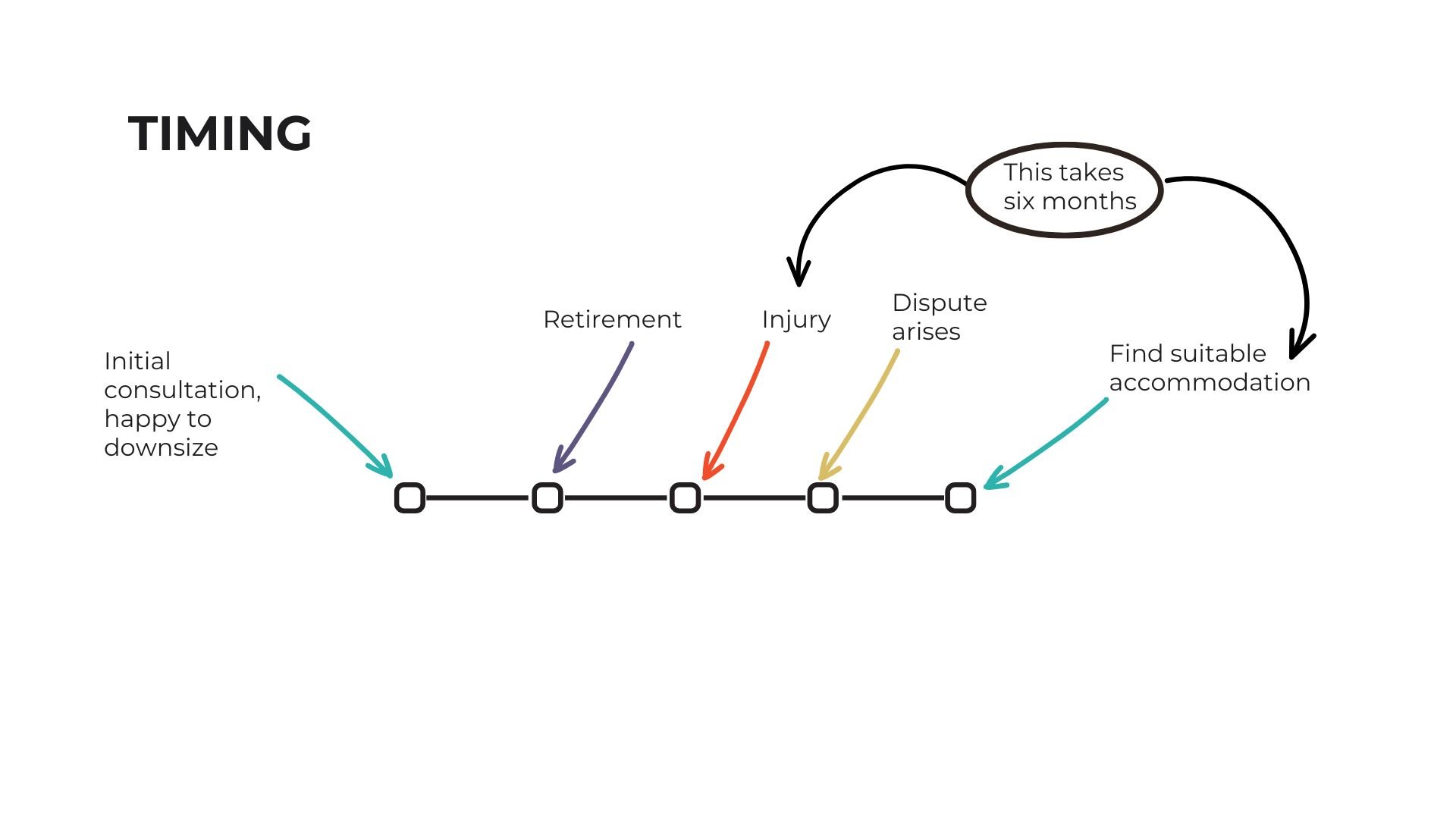
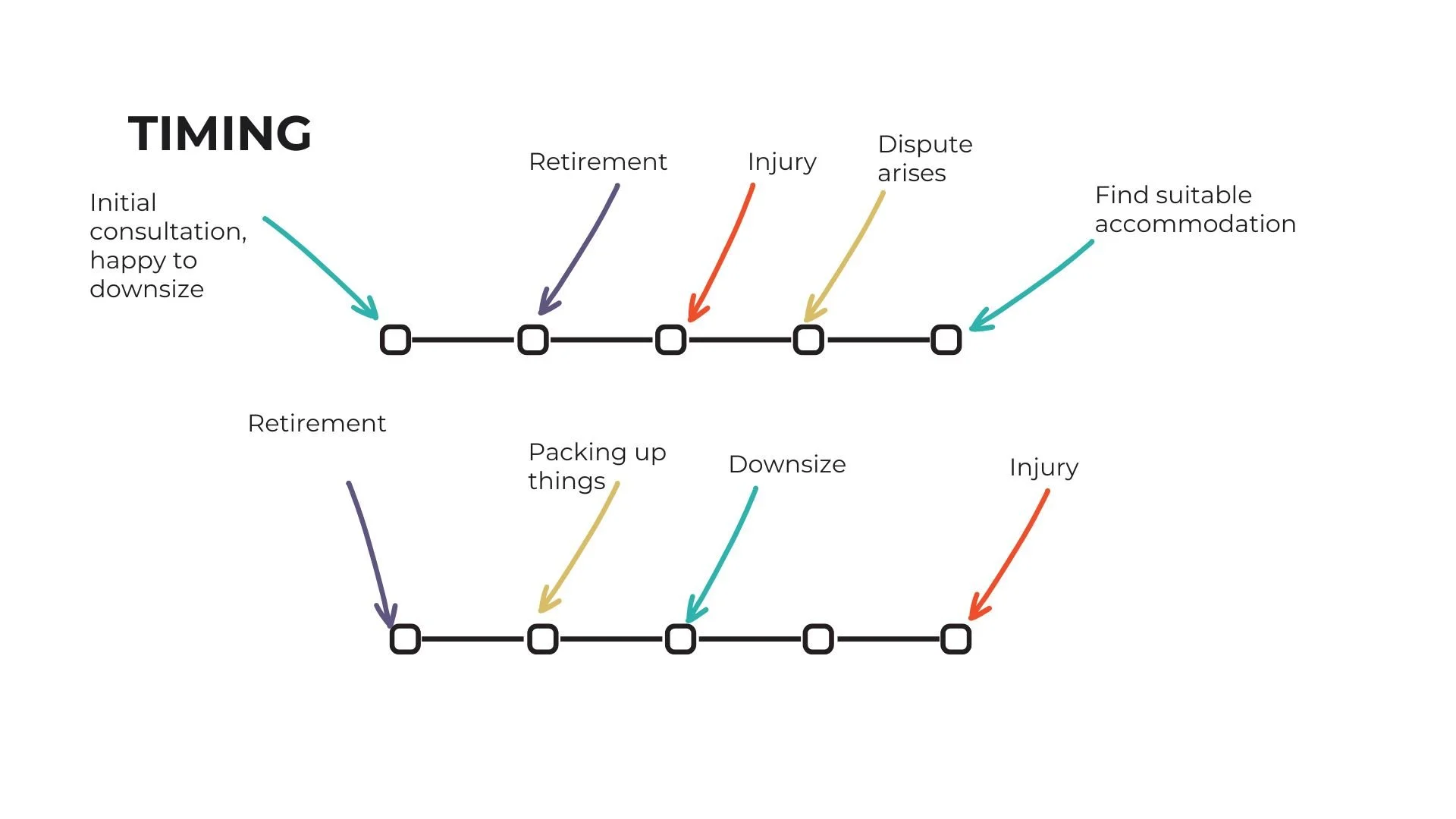
In the above graphic we look at the plan to downsize. Most clients who are still working, or are in early retirement agree that they will downsize or move into a retirement village “when the time comes”. The problem is that they don’t actually take any steps to deal with it until they are injured, or their health has otherwise deteriorated. If we estimate that packing the house, selling the house and finding a suitable place to downsize to will take six months then this begs the question, where is that person going to live for six months? Can they privately fund significant care in the home, or time in a respite setting for that six months? If they are injured who is packing their house?
Just downsize quickly
A quick Google will show you that the estimate of six months is probably too short. The previously mentioned ABC articles talks about people who have looked for years, and are thinking of switching suburbs. The survey that is linked from the ABC article looks at availability of housing per 1,000 retirees. Even in a country area like Eurobodalla it says there are 0.8 suitable houses available per 1,000 retirees. This is based on cost and the size of the house (3 bedrooms or less), not other factors like whether the bathroom can be accessed by someone using a walking aid, or how many steps there are between the car and the front door.
If the client is injured and needs housing now, that does not mean that more houses will suddenly become available. They just have to wait for the next option, and the next, until something suitable crops up. When something suitable does crop up they can expect competition from the other retirees who are also fighting over a limited pool of options.
Starting earlier
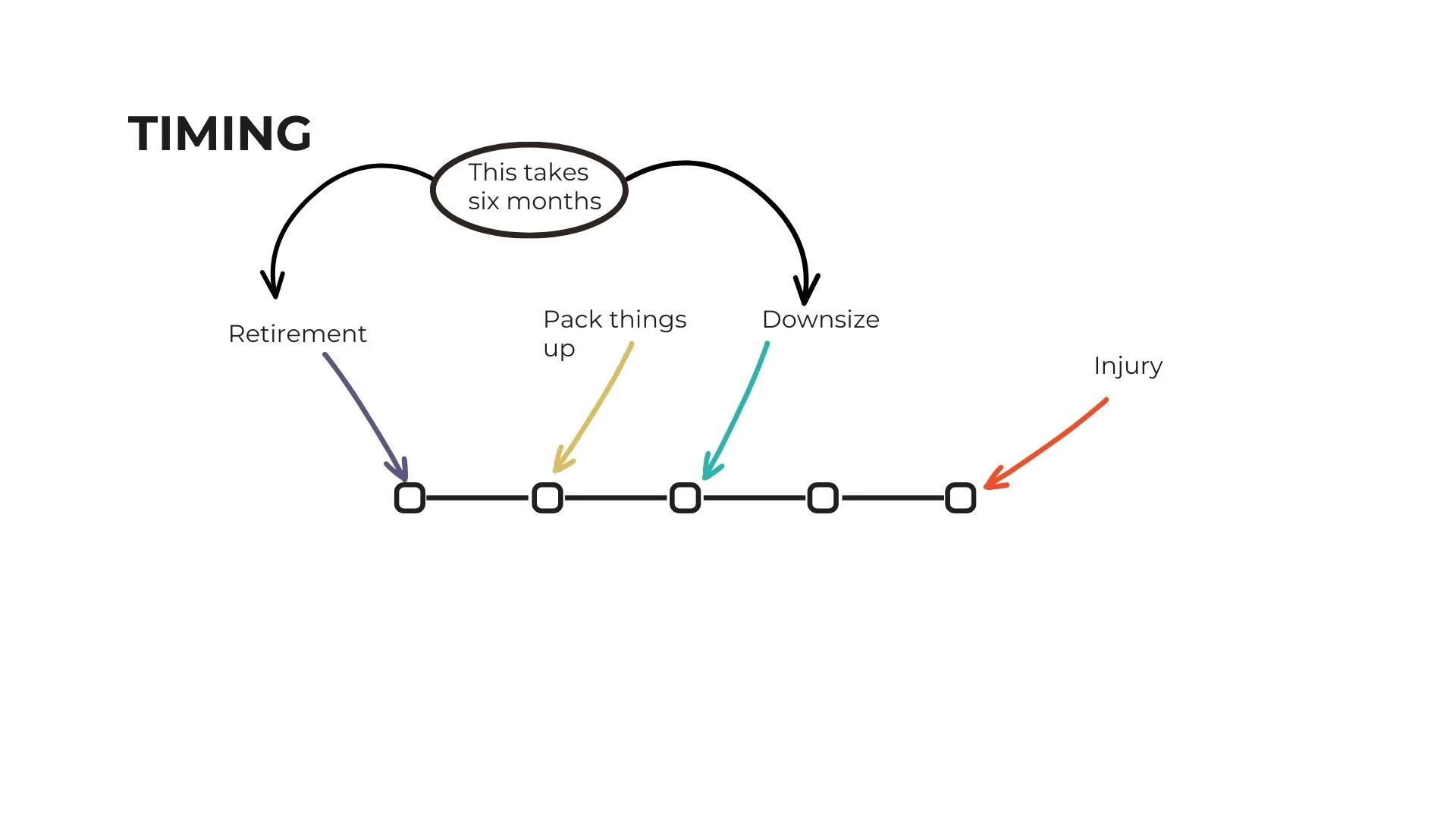
What if we could convince our clients to do start earlier, like the example at the bottom of this graphic. What if clients who were in early retirement began packing and looking to downsize in the suburb they prefer, near their trusted medical professionals, and with an appropriate bathroom or entry area for the house. This would increase their chances of aging at home, and significantly decrease the risk of a dispute. Additionally living in a home that has less trip hazards, less stairs, and a more practically designed bathroom will reduce the risk of injury in the first place.
We also need to ask follow up questions after they say “I will downsize”. We need to ask the clients what would happen if they are injured or suffer a set back before they have downsized, do they plan to fund in home care to bridge the gap and if so from which asset or income stream? Do they plan to move into aged care in the short term while an alternative accommodation is found for them, and if so who is packing their house and finding this accommodation? How does all of this change once their spouse has died, are they expecting an adult child to do this and if so, have they had that conversation?
Timing of the dispute
In a recent Webinar we looked at the case law from the first half of 2026 in relation to Powers of Attorney and Aged Care, and not surprisingly almost all of the disputes arose at the time that the person in need of care had an injury, or stroke, or otherwise experienced a sharp increase in their needs. Families are not prepared for this situation, and begin arguing about the best outcome. In many cases the government departments get involved. None of this is a desirable outcome.
We see these disputes at this time because the decisions are complex. They are not binary decisions, stay at home or move into care. The family members who advocate for the person remaining at home are often accused of not understanding the complex needs of the person, or acting out of self interest. In reality, we know that our clients mostly do want to remain at home, so that family member is probably fighting for exactly what the client wanted. In all of the cases the needs of the person were not considered because they were not known. Downsizing earlier won’t make the process any quicker. It will mean that when the injury, or escalation in need occurs, the client is already home. Additionally writing down the preferences for the client will help the family to advocate for them.
This isn’t a legal problem
All this talk of planning and aging might leave you thinking that this is not a legal problem, and if you think a Power of Attorney is merely a document you would be right.
I personally think that, even if a Power of Attorney was only a document I would still want a better outcome for my clients. However, a POA is not merely a document, in fact most clients tell us that they want -
to make sure that this person makes decisions for them if they lose capacity; or
to avoid any arguments or issues.
As to the first point, in the cases that we looked at in the recent Webinar about aged care and the conflict clause we saw that often when a dispute erupted either the Public Trustee became involved (and charged their fees), or one person was removed, or a decision that this person had made was over ruled. The outcome of the cases is almost always to move away from the original position, in most of the cases there was a Power of Attorney. This is not what your client has instructed you that they want. It is incumbent upon you to explain how to avoid this mess.
In relation to the second point, avoiding arguments, as mentioned above the arguments almost always occur when the person needs to move into care, or have care come into the home, or otherwise sees an escalation in their needs. You cannot actually avoid the argument without confronting this decision. As lawyers we know that “my family knows what I want” is nonsense. The best way to avoid arguments is not preparing a Power of Attorney. It is having a written, well thought out and achievable plan for what aged care or capacity issues will look like for your client.
If you are providing merely a document, and are plain that it is only a document, then fine you can ignore all of this. If you are marketing yourself as providing more, or if your retainer indicates that you will provide more, then all of this becomes your problem.
So what is the solution?
While getting proper instructions from the client is about heading off abuse and conflict, it is also about helping them to have the retirement that they want. This involves more than naming an Attorney. You know that. But how do you get the client to join you? We need to get them to meaningfully engage with their plans for aged care, including writing down some of those plans. There are a few ways we can look at doing that, including -
Taking very brief, initial instructions from them on a few points, so that they can have a short Letter of Wishes about aged care in front of them to get them started;
Having a more comprehensive Letter of Wishes available for more complex instructions;
Explaining their options as if it is about them taking control, not out of a place of fear; and
Discussing an Advance Care Directive again as a way of taking control, and writing down their preferences.
The online learning
In June we had a Webinar to discuss Powers of Attorney and the Initial Consultation, how do we get more than the name of the Attorney during this initial consultation? You can get the recording and the documents to go through the course at your own pace. The documents include -
Case summaries from 8 different 2026 cases dealing with disputes around Powers of Attorney and payment for aged care;
A file note to use in your initial consultation, to take some bespoke instructions in relation to aged care to get the client started;
A set of slides for you to use in your own practice explaining why aged care is not a binary choice between staying at home and moving into care; and
The slides from the Webinar itself, where we go talk about how to help the client to engage meaningfully, rather than hoping that they can ignore it and it will go away.
This training is to help you to revisit your Initial Consultation, change your focus, so that you can get clients to engage meaningfully with their Power of Attorney. The training costs $100 per person and when we run the event live again you will be invited to attend live. In the mean time though you can get started yourself, with the recording and the documents.
In keeping with previous CPDs, you will get a $50 discount code if you email a requisition from the Supreme Court in relation to an Estate matter and provide enough information for the requisition to make sense. I will bundle them together and they will form part of the subject matter material available to participants. Email it to janis@janisconsults.com and then I will send you the discount code and a survey for you to complete with further questions. If you give me two requisitions you could attend for free.
If you have any questions then please reach out to me at janis@janisconsults.com
NSW Estate Lawyers Facebook Group
Did you know about the free Facebook Group? This is a group for NSW Estate Lawyers to discuss things that are particular to practising Estate law in this State. Here are some examples of things we discussed in August 2026 -
(1) Did you know that the Law Society’s Costs Disclosure precedent has been updated?
(2) Does anyone have experience with an undertaking for a minor?
(3) Why are people registering for AML, is it because of conveyancing, or for one of the other reasons?
If you would like to join you can just search for “NSW Estate Lawyers” in groups on Facebook, please make sure that you answer the questions because otherwise your application is automatically filtered out. The group is just for lawyers, so we need to check your name against the register.