The problem
In most matter, most of the risk in a matter comes at the beginning of the matter. As we move through the matter and understand it more, and get more opportunity to provide advice or assistance, we reduce the risk through our involvement. The flat hourly rate doesn’t acknowledge the risk element of the cost of running a business. The flat hourly rate also doesn’t acknowledge the different risk profiles in different matter types.
Cost recording v time recording
While there are a lot of reasons for the legal profession to move to more regulation around costs, one of the outcomes of that change that lingers today is measuring everything by an hourly rate. There are many things that cannot be measured by an hourly rate, because they aren’t applied equally across the firm, or because they aren’t a time based cost including -
the ongoing cost of maintaining safe custody
the time spent dealing with issues with suppliers, some of whom only apply to one cost area, e.g. Infotrack was mostly related to conveyancing before the AML changes
the stress caused by difficult matters, which makes us less effective in other matters or requires more time to transition between matters
the choice between urgent and non urgent work impacts client retention, and is rarely about preferred clients (it is usually about what is legitimately more urgent)
some matters simply pay quicker than other matters (so the cost of waiting to be paid until the end, and the difference between waiting six weeks, six months and two years)
It is very difficult to price these issues into an hourly rate.
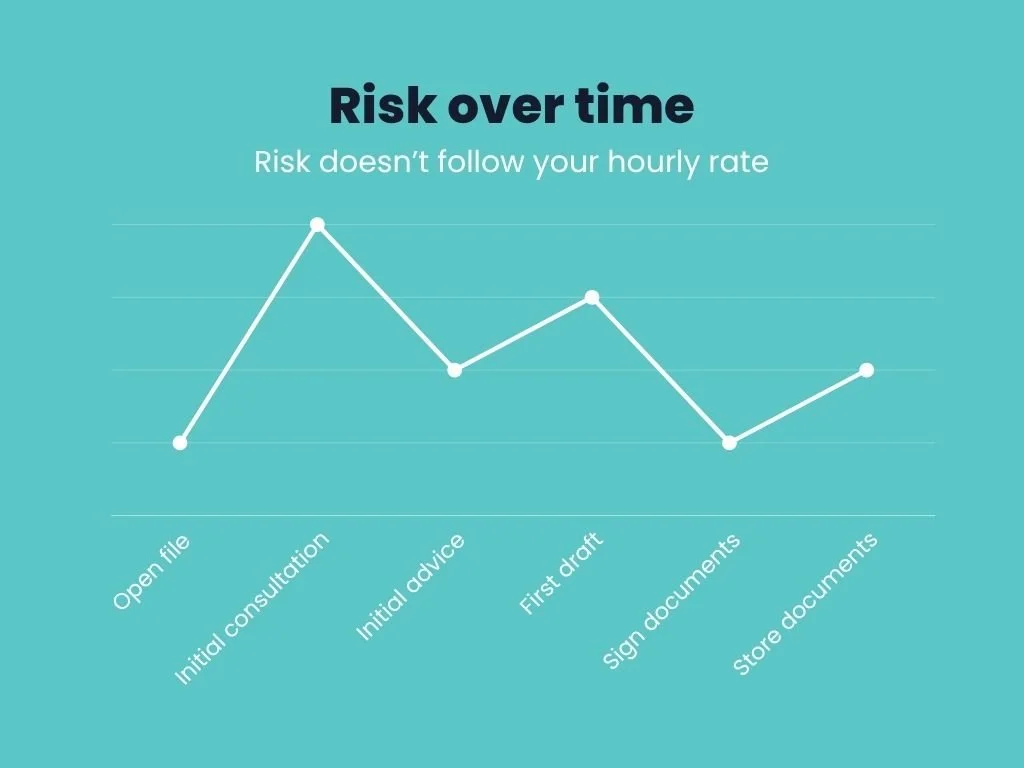
Risk is not a straight line
One of the biggest costs that we take on as lawyers is risk. It isn’t just about our insurance premiums, but also how much time we spent on our training, on our systems to try to fool proof them, and on constantly revisiting our documents. Measuring this is difficult not only because these tasks infiltrate everything that we do, but because different matters have different risk profiles. In fact, different stages of the same matter have different risk profiles. If we take the above graph as an example, in a standard estate planning matter the risk might look like -
Opening the file - low risk, not a lot has happened, we cannot be criticised as much
Initial consultation - high risk because we have met them and advised them, and they have some verbal knowledge and might think they now know what they are doing (without us)
Initial advice - brings the risk back down, because we can put some things in writing, and record what not to do (don’t do this, we don’t advise on that)
First draft - no one wants to be involved in the matter where there is a draft sitting on someone’s desk for three months, and then they die
Sign documents - relief, they have signed, they have a plan, hallelujah
Storing documents - the risk starts again, not just the risk of losing the document but the risk that we are storing this document ad infinitum because the family won’t know about us, or the client does a new will in ten years
Additionally if a client stops instructing us at a stage earlier than signing the documents then our risk is higher than if they follow through until the end.
A flat hourly rate doesn’t capture this. One way to deal with this is to front load our advice (so have pro forma advice more readily available) and front load our costs. So in a fixed fee matter we are always stealing reasonable costs from somewhere, when we prepare estimates and spell out the stages in our Costs Disclosure we should be including higher costs at the start of the matter not only to protect us if the clients pulls up stumps, but also because it is an accurate reflection of the actual cost of the matter.
There is also the risk associated with couples
Many of the issues flagged in my previous blog post, which you can read here, apply almost exclusively to couples. So why are we using the same hourly rate to calculate our fees for couples and for singles?
While an hourly rate is an important metric when setting our fixed fee prices, and I am not proposing that you stop measuring how many hours that you spend on matters, we cannot rely solely on the hourly rate.
Your price IS COMPLICATED
Whether it is fixed fees or an hourly rate your price is complicated. While clients love to compare our prices or hourly rates as if they are comparing apples, it is important that you do not do that within your own practice. You are not comparing the same thing when you look at the price for singles and couples. You are not comparing the same thing when you look at the price for a one hour long initial consultation and a one hour long signing appointment.
While it is not practical to abandon the concept of an hourly rate altogether, when you are looking at your prices and your pro forma estimates in your costs disclosure you need to think beyond the hourly rate. One of the ways that you should do that is by asking yourself, where does this matter sit in relation to risk, as compared to other matters types in my office? Where does this stage of the matter sit in relation to risk, as compared to other stages of this same matter? Should I change my price to match that?
Three tiered pricing
Three tiered pricing can be a really effective strategy for focusing your client’s attention where you want it. I am going to be talking about that in the upcoming Webinar on making the Power of Attorney the center of your marketing, and using three tiered pricing to give an entry point to the “simple” matters that more naturally points the clients towards the importance of a proper Estate Plan. You can find out more about that here.
I am also working on a set of precedents dealing with a three tiered pricing system, including costs disclosure and easy to use checklists. If you want to find out more about those as they are developed, and get a discounted offer when they are ready, then you could join the waiting list.