Have we become focused on wills and estate disputes at the expense of the Power of Attorney? What do the statistics say about the likelihood of either dispute? Why should we shift our focus back to the Power of Attorney?
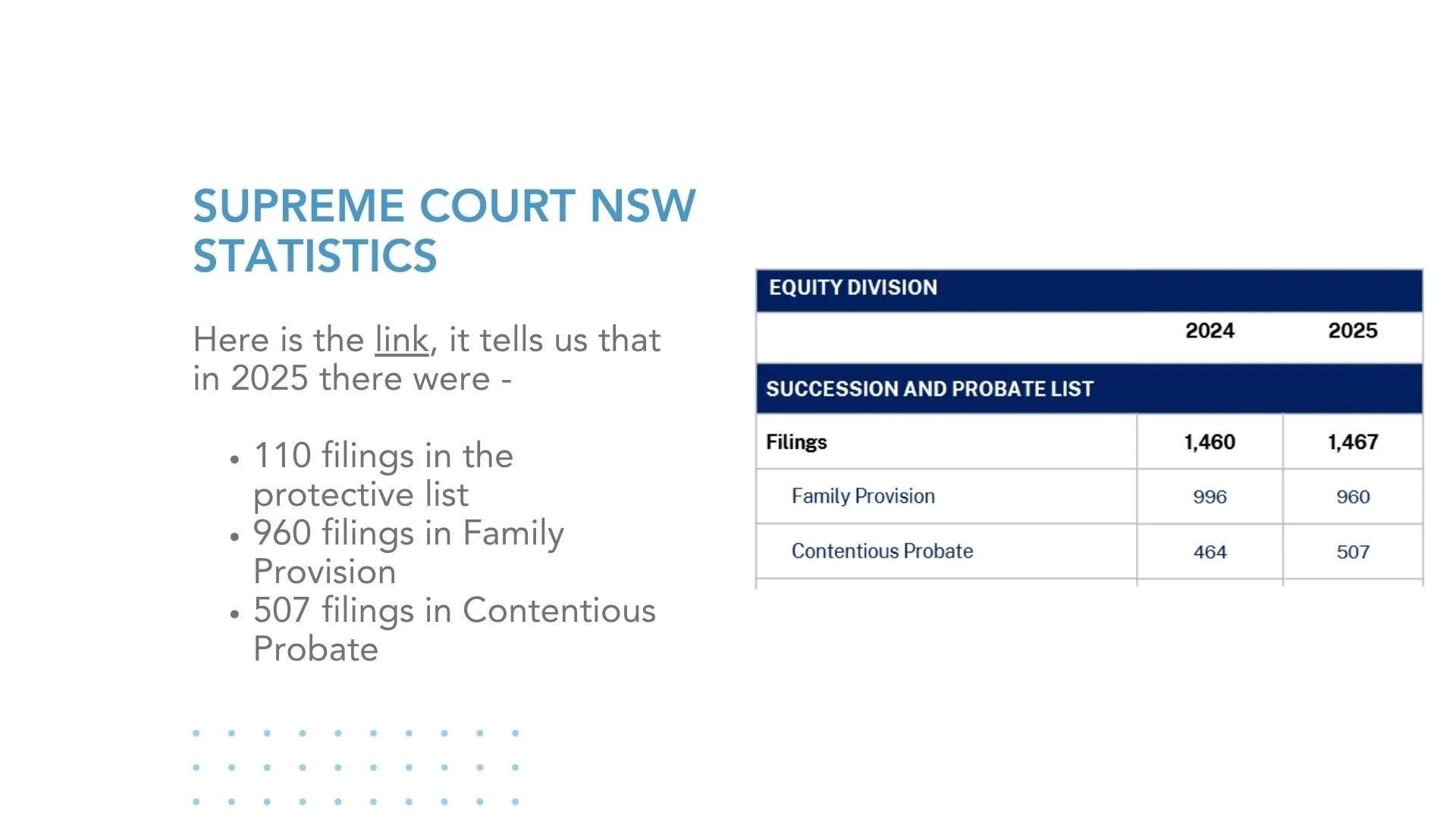
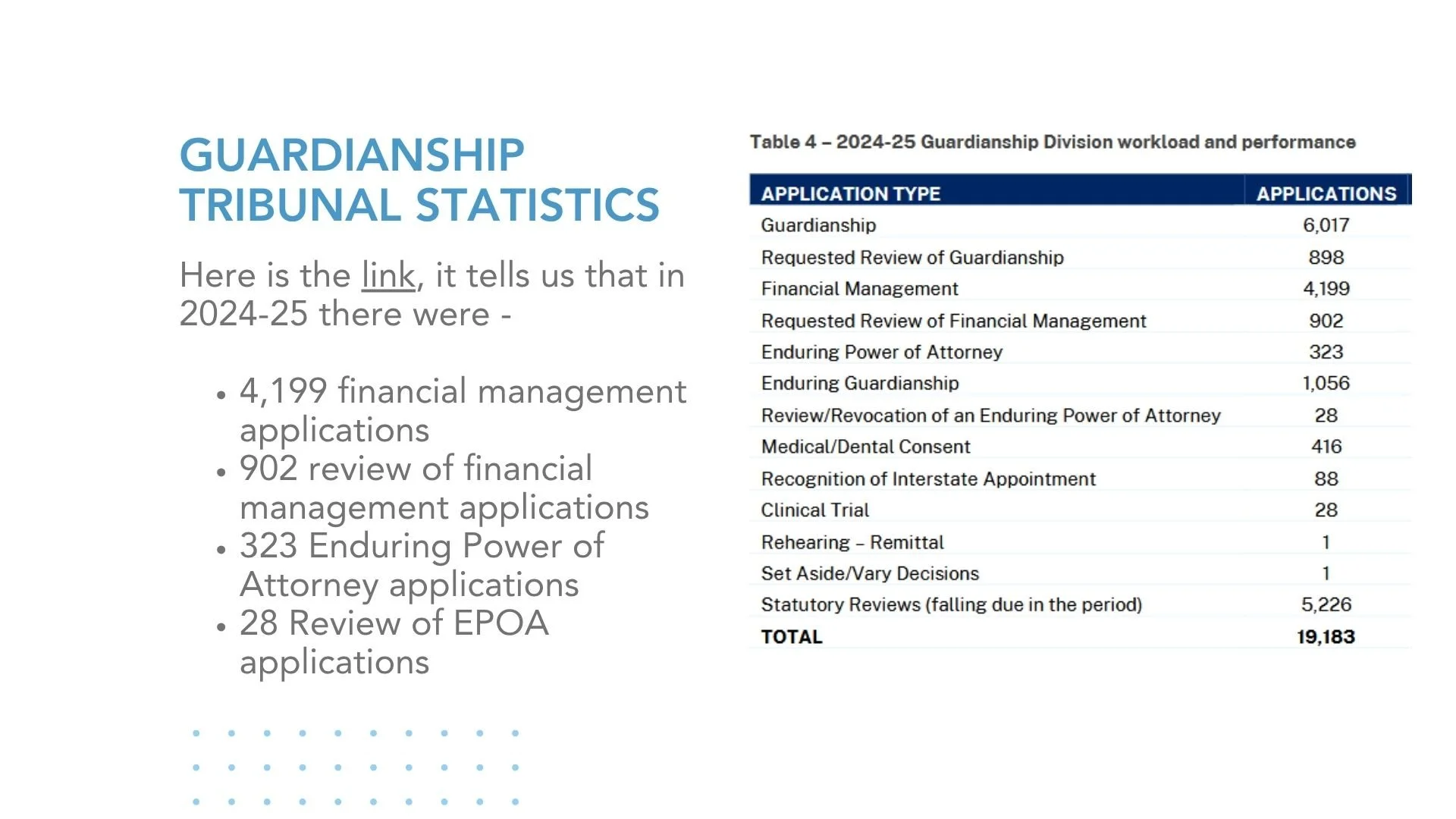
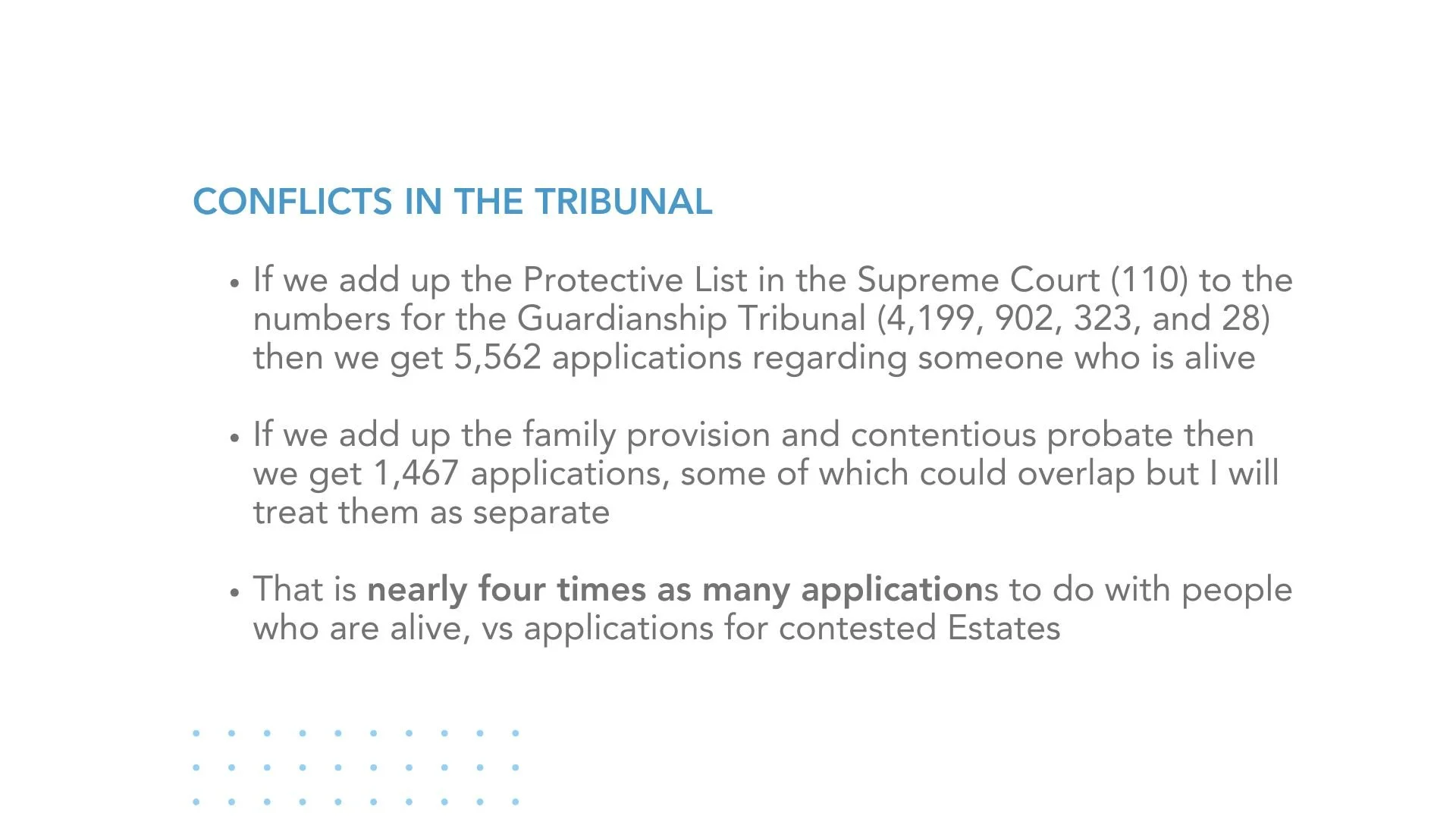
If you look at the statistics, which we will do during this Webinar, you will see that there is a far greater likelihood of a dispute while your client is alive than after they have died. Additionally, if the dispute happens while they are alive, there is a risk that the Public Trustee will become the decision maker where as the risk of this happening after death is just significantly lower. You can read the Guardianship Tribunal statistics here.
LESS WILLS THEN?
So am I saying that we are focused on Wills too much? No, not at all. In fact I think that the reason that the statistics for Wills disputes are so much lower is at least in part because of the work of the legal profession to get people to talk about Wills. While our culture is still slow to talk about death we have gotten people to understand that preparing a Will is just good life admin, and a loving thing to do for your family.
Most clients are doing their Power of Attorney as a result of doing the Will, they aren’t coming to see us to do that. I think the time has come to consider how we approach the Power of Attorney, and why. We do talk about it when we want to protect against elder abuse, and that is important, but in the absence of elder abuse this is still a critical document for our clients.
third party assumptions
As well as the risk of the Public Trustee being appointed as the decision maker, a risk that doesn’t really exist in Estate matters, there is also the third party assumptions that are brought to bear on these people like -
If the family member understood the severity of the medical needs, they could not possibly think the family member would prefer to remain at home, therefore they must not understand the severity of the medical needs - see for example HCI v NSW TG [2026] NSWCATAD 87
Where a home has been purchased for Mum to live in, mostly with the daughter’s money, and the daughter is the attorney, and providing in home care, the mother needs the protection of a financial manager (so we should suspend the POA) - see for example YQR v YQS [2026] NSWCATAP 95
These are just two of the assumptions that I see in the cases, not just these two cases but repeated time and time again. The Public Trustee and the Tribunal have no reason to believe that it is wrong to say the person wanted to remain at home, when survey after survey says that Australians want to aged and die at home with care coming into the home. The Public Trustee and the Tribunal have no reason to believe that the parent who is being provided for financially and practically needs financial management, and certainly the mother would prefer not to pay the Public Trustee’s fees for that management. But again, we see these types of decisions over and over again in the cases.
The Public Trustee
The risk of the appointment of the Public Trustee should on it’s own be enough to get us to pay more attention to this document. The statistic in the slide below is taken from the same statistics that I am referencing above.
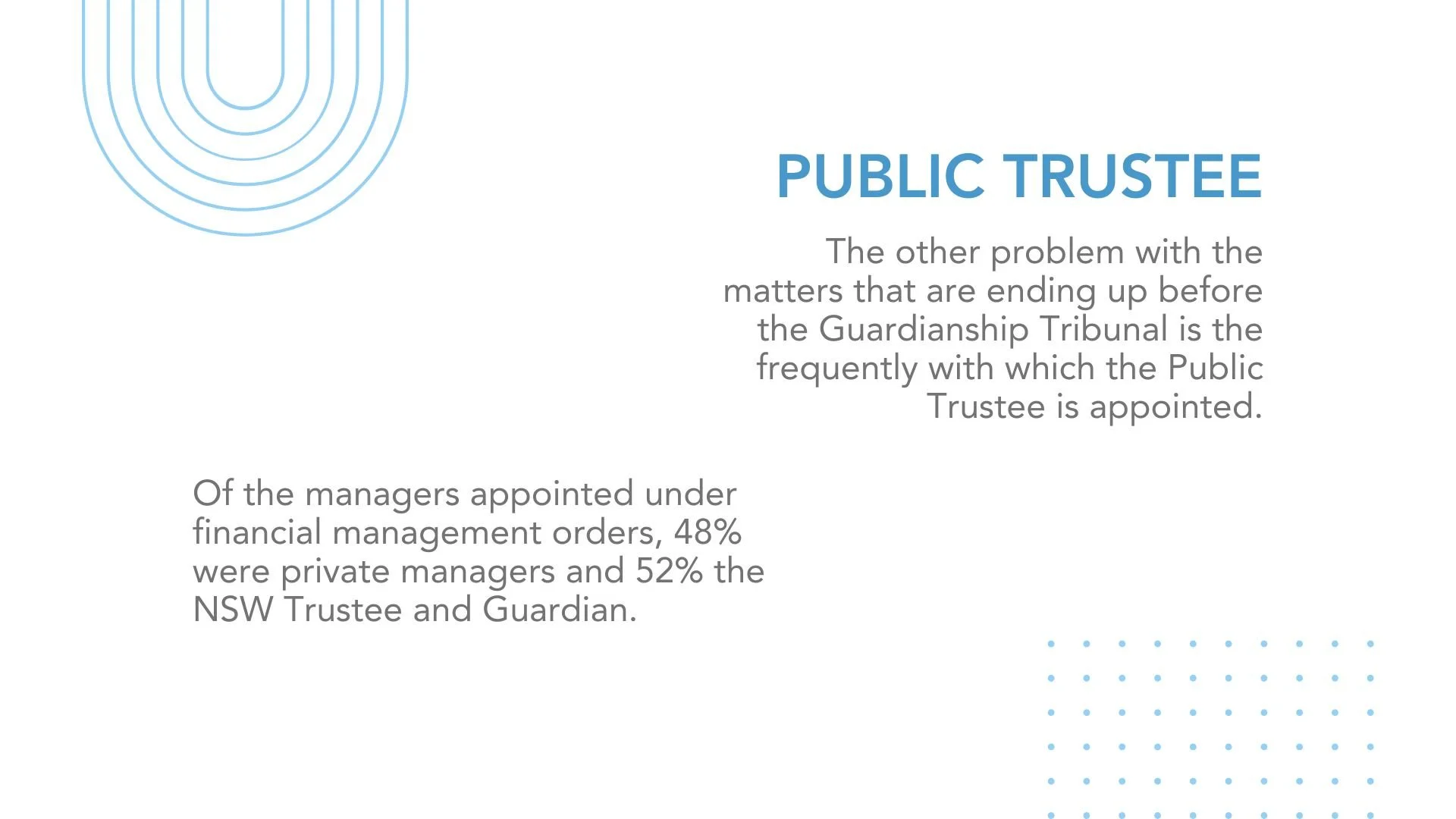
Most of our older clients would do anything to avoid being managed by the Public Trustee. Most lawyers would agree that the fees that they charge, and the approach that they take, are reason enough to avoid this on behalf of the clients. While the clients may not specifically tell us that the reason that they are preparing a Power of Attorney is to avoid the appointment of the Public Trustee, we know that the consequence of giving merely peripheral thought to the Power of Attorney and their aged care may be the involvement of the Trustee or the Tribunal.
We know that clients don’t want to talk about this. We know because we have tried to get them to engage with their aged care plans. Perhaps we need to re-think how we do that. Now what will work is very much dependent upon the client in front of you. Some clients will want to do the in depth work, you will need to give them the Letter of Wishes with the deep decision making. Some clients will only engage peripherally, but a short document setting out two paragraphs in relation to their aged care preferences is better than nothing at all. The fact that clients engage begrudgingly, and differently, is not a reason for us to stop trying.
The CPD Event
When you register you will get straight away -
The video recording of the Webinar to watch at your own pace;
The slides from the Webinar, and the statistics and surveys that are referred to; and
A copy of the questions that everyone else was asking on this topic, and the group answers.
In keeping with previous CPDs, you will get a $50 discount code if you email a requisition from the Supreme Court in relation to an Estate matter and provide enough information for the requisition to make sense. I will bundle them together and they will form part of the subject matter material available to participants. Email it to janis@janisconsults.com and then I will send you the discount code and a survey for you to complete with further questions. If you give me two requisitions you could attend for free.
If you have any questions then please reach out to me at janis@janisconsults.com
NSW Estate Lawyers Facebook Group
Did you know about the free Facebook Group? This is a group for NSW Estate Lawyers to discuss things that are particular to practising Estate law in this State. Here are some examples of things we discussed in August 2026 -
(1) How many of the beneficiaries would you get to sign the Deed of Family Arrangement in this particular situation?
(2) How would you deal with an overseas client whose assets are mostly in Australia? Should I be referring them off for an overseas Will too?
(3) Have you seen the updated Law Society’s precedent for Costs Disclosure? It was updated 15 July 2026 apparently, here is the link.
Of course more recently there is a lot of discussion about pragmatic issues with the new online system. We might also share the occasional post that only other lawyers who practice in this area will appreciate. The idea is to help and support each other, and share information that is helpful.
If you would like to join you can just search for “NSW Estate Lawyers” in groups on Facebook, please make sure that you answer the questions.